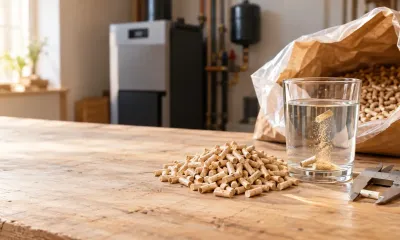
Why pellets cause clinker and "cakes" in the burner: 7 causes and what to do
"Cakes", "clinker", "the pellets are coking", "I have to clear it every four hours" - the most common complaint from pellet boiler owners during frosts. There are seven causes, and only half of them lie in the fuel. Let us look at how to work out in one evening what is happening in your case and what to do about it.
What a "cake" is and why it forms
Wood pellet ash consists of minerals: potassium, calcium, silicon. Normally it remains a dry grey powder and falls out of the burner pot. But if the temperature in the fuel bed rises above the melting point of this ash (about 1,200 °C for clean wood, 700-900 °C for ash containing bark, soil or husk), the minerals melt and fuse into a hard porous crust. That is the cake, or clinker. It blocks the air holes, the burner chokes, the flame turns yellow and sooty, the boiler cannot reach temperature, and the controller shuts down with a "no flame" or "overheating" error.
So a cake forms when two conditions coincide: the ash contains low-melting minerals and the pot is too hot. The causes below are about exactly these two things.
Cause 1. Bark, sand and soil in the pellets
This is the most common fuel-related cause. Sawdust from stem wood contains almost no silicon, but bark and wood "from the ground" do: sand and clay get into the bark during harvesting and transport. Silicon combined with potassium is exactly the mix that melts at 750-850 °C. Signs: the pellets are dark with black specks, the ash is brown or black rather than grey, and cakes form even with a properly tuned burner. Under ENplus A1, ash content is up to 0.7% and the raw material is bark-free; A2 allows bark, and it is A2 and unclassified "industrial" pellets that most often cause cakes.
What to do: check the batch with the water test and look at the bottom of the bag (details in the article "How to check pellets at home in 5 minutes"); take the next batch as A1 or with an ash content test report; do not buy a "season's supply" of pellets you have not tried - that is what the trial bag is for.
Cause 2. Agro pellets or a blend in a household burner
Sunflower husk, straw and maize contain 5-10 times more potassium than wood. Potassium lowers the ash melting point to 650-750 °C, and in a small household burner designed for wood, clinker forms within 3-4 hours. Sometimes agro pellets are mixed into wood pellets to cut costs: the pellets still look light, but the ash is sticky and dark. Sign: a smell of husk when burning, ash that looks like fused sand.
What to do: agro pellets belong only in retort burners with moving grates and in boilers where the manual allows them; a household flame burner should get wood pellets only. Details in the article "Agro pellets: which boilers they suit".
Cause 3. Too little air or a poorly tuned burner
When there is less air than complete combustion requires, burning shifts deeper into the bed, the pot becomes hotter than it should be, and unburnt particles fuse together with the ash. A typical story: the burner was tuned in autumn for one batch, in winter a different one was bought (denser or longer pellets), the feed stayed the same and now there is not enough air. Signs: a yellow sooty flame instead of a white, clear one, soot on the inspection window glass, a cake "growing" from the edges of the pot.
What to do: increase the air supply (fan) by 10-15% or reduce the fuel feed per cycle; in standby mode shorten the pause so that the bed does not "bake" during start-up. It is normal to re-check the settings after changing batches.
Cause 4. Too much fuel and a thick bed in the pot
If the auger feeds more than can burn, the bed in the pot grows, the lower pellets burn without air as if in a forge, and the temperature at the centre of the bed exceeds the ash melting point. This is often the result of "pushing" the boiler in frosty weather: the output was raised, but the pot is not designed for that amount. Sign: a thick round cake shaped like the pot, fused to the metal underneath.
What to do: reduce the feed time per cycle and lengthen the pause; if the boiler lacks power, that is a question about the boiler, not the fuel.
Cause 5. Weak draught or a dirty boiler
Ash and soot in the heat exchanger, a blocked chimney, a closed damper: the combustion gases cannot escape, air cannot pass through the bed, and the temperature in the pot rises. This is often confused with "bad pellets" because the symptoms are the same. Sign: the problem built up gradually over several weeks rather than appearing with a new batch; draught on a cold boiler is weak.
What to do: clean the heat exchanger and chimney, check the door seals and the damper. A pellet boiler should be cleaned every 2-4 weeks during the season regardless of fuel quality.
Cause 6. Dust and fines in the hopper
Dust from the bottom of the bags and brittle pellets that have crumbled in the auger land in the pot in a heap, flash-burn, overheat the zone and fuse into a crust together with the ash. On top of that, dust clogs the auger: "the boiler stopped on the morning of 1 January" is often down to exactly this. The ENplus standard allows up to 1% fines, and "export quality" 15 kg bags meet it; big bags and pellets that have been re-poured several times contain noticeably more dust.
What to do: do not shake the "leftovers" from the bags into the hopper, clear the dust from the bottom of the hopper once a month, buy pellets in intact, tightly sealed bags.
Cause 7. Wet or swollen pellets
A pellet that has absorbed moisture in storage swells, feeds poorly, burns unevenly and produces more smoke and unburnt residue; moisture also changes the combustion temperature of the bed. Signs: the pellets are dull, thickened and cracked, and the hopper smells damp.
What to do: store bags on a pallet under a roof and big bags indoors only; do not try to "dry out" a swollen batch in the boiler room, but burn it in small portions mixed with good pellets.
How to tell in one evening whether it is the fuel or the burner
| Sign | Most likely the fuel | Most likely the burner, boiler or draught |
|---|---|---|
| When it started | with a new batch | built up gradually |
| Ash colour | brown, black, sticky | grey, dry, but fused |
| Flame | normal, yet cakes still form | yellow, sooty, soot on the glass |
| Bottom of the bag | a layer of dust, dark pellets, smell of husk | clean, light-coloured pellets |
| Test with a trial bag from a different batch | no cakes | the same cakes |
The simplest diagnostic tool is a bag of pellets from another manufacturer or of A1 grade, burned in the same burner with the same settings. If the cakes disappear, the fuel is to blame. If not, work on the air, the feed and cleaning.
What not to do
Do not knock the cake out of a hot pot with a metal tool: the grate will deform. Do not pour water on it. Do not set the air "to maximum" permanently: pellets will fly out of the pot unburnt. And do not judge a whole batch by one day of hard frost: at peak loads any burner forms more clinker, and one cake a day at -20 °C is still normal, whereas one every four hours at -5 °C is not.
So that you do not have to argue with the seller after buying, we provide a certificate with the ash content for every batch, send a trial bag via Nova Poshta and pack our wood pellets in 15 kg bags, screened to remove dust.
Questions and answers
Is it normal for clinker to form in a pellet burner?
A small cake once a day in frosts of around -20 °C is still normal: at peak loads any burner forms more clinker. But if you have to clean the pot every four hours at -5 °C, there is a problem with the fuel or the settings. Normal wood pellet ash is a dry grey powder that falls out of the pot by itself.
Which pellets form the least clinker?
ENplus A1 wood pellets: ash content up to 0.7% and bark-free raw material. Ash from clean wood melts only at about 1,200 °C, whereas ash containing bark, sand or husk melts at 700-900 °C, which is why cakes most often come from A2 and unclassified "industrial" pellets. What else to look for when choosing is covered in the article how to choose pellets for your boiler.
Why do pellets burn with a yellow, sooty flame?
A yellow sooty flame and soot on the inspection window glass almost always mean that the burner is short of air or has not been re-tuned after a change of batch. Increase the fan air supply by 10-15% or reduce the fuel feed per cycle. If the problem built up gradually, check the draught and the cleanliness of the heat exchanger and chimney.
How often should a pellet boiler be cleaned?
The heat exchanger and chimney of a pellet boiler are cleaned every 2-4 weeks during the season regardless of fuel quality. A dirty boiler reduces draught, the temperature in the pot rises and cakes form, which are often wrongly blamed on "bad pellets". In addition, it is worth clearing the dust from the bottom of the hopper once a month.
How do I remove a cake from the burner pot properly?
Do not knock the cake out with a metal tool while the pot is hot, as the grate will deform, and never pour water into the pot. It is also a bad idea to set the air supply to maximum permanently: pellets will start flying out of the pot unburnt. After cleaning, it is important to find the cause (fuel, feed settings or draught), otherwise the cake will form again.
Can agro pellets be burned in a household pellet burner?
Not in a flame burner designed for wood. Husk and straw contain 5-10 times more potassium, the ash melts at 650-750 °C, and clinker forms within 3-4 hours. Agro pellets are suitable for retort burners with moving grates and boilers where the manual allows them; details in the article agro pellets: which boilers they suit.
Buy the fuel covered in this article
Prices per tonne and per bag, stock and delivery across Ukraine are on the category page. For wholesale: special terms.