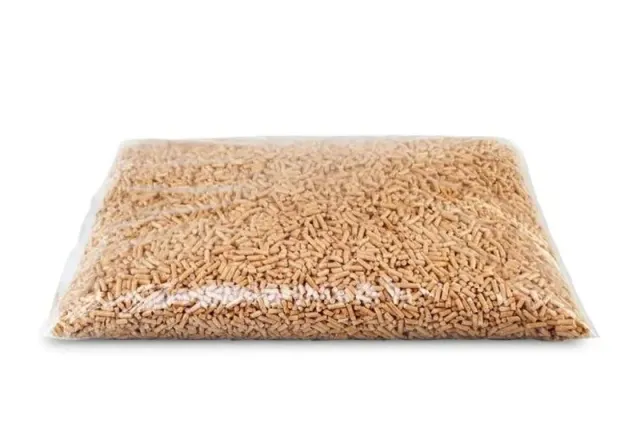
Pellets are compressed granules 6 or 8 mm in diameter made from wood sawdust or sunflower husk. They are loaded into the hopper of a pellet boiler or burner, and from there the fuel is fed automatically: one load lasts several days without anyone touching it. That is why private homeowners choose pellets over firewood and coal, and boiler houses use them for premises with no gas connection.
Thermera sells two types of pellets. Wood pellets are made from softwood or hardwood sawdust: the highest calorific value, minimal ash, suitable for any pellet boiler, including domestic ones with a small ash pan. Wood pellets come in two diameters: 6 mm, the standard for domestic boilers and burners, and 8 mm, for boilers designed for 6-8 mm pellets, boiler houses and industrial burners. Each diameter comes in three grades: Standard pine, Premium DIN+ pine with minimal ash content, and 100% oak with a dense pellet for long burning. Sunflower husk pellets (agro pellets) are cheaper than wood pellets per tonne, but produce more ash and need a boiler with mechanised ash removal or regular manual cleaning. They are a practical option for industrial boiler houses, greenhouses and owners of boilers designed for agricultural fuel.
Packaging: 15 kg bags (wood) and 25 kg bags (agro), big bags of about 1 tonne and bulk delivery by truck. Bags are more convenient for a home: they are easy to store and to top up the hopper with. For boiler houses and purchases of several tonnes or more, big bags or bulk are better value, as the price per tonne is lower.
The price depends on the type, diameter, grade, packaging and volume: current prices per bag and per tonne are in the table further down this page. Delivery across Ukraine: from our warehouse with our own transport, and to other regions by carrier, on pallets or in big bags. Wholesale buyers and boiler houses get separate terms: bank transfer with VAT, a supply contract and documents for each batch.
Not sure which pellets suit your boiler? Read "How to choose pellets" in our buyer's guide, order a trial bag or give us a call: we will advise based on your boiler model and work out how much you need for the season.
How to choose pellets: a quick guide
Quality class. For wood pellets, the benchmark is the ENplus standard. Class A1 means ash content up to 0.7%, for domestic boilers; A2 means up to 1.2%, for boilers with a larger ash pan and for boiler houses. The certificate must be issued to a specific producer, and the certificate number can be checked on the ENplus website. If a seller writes "ENplus" without a number, that is not a certificate, just a word on the bag.
Diameter. 6 mm is the standard for domestic pellet boilers and burners; 8 mm is found in industrial ones. Check your boiler's manual: a burner designed for 6 mm feeds 8 mm pellets less reliably.
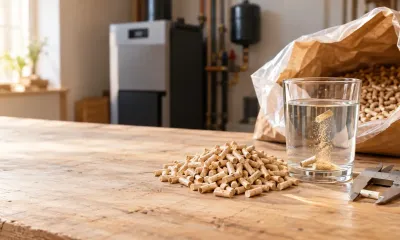
What you can see without a lab. Good pellets are smooth, shiny, of even length, without cracks and with almost no dust at the bottom of the bag. Wood pellets range in colour from light beige to light brown; dark pellets or pellets with black specks often contain bark. Pellets dropped into water should sink and after a few minutes soften into a uniform mass, not float or leave a film.
Packaging to suit the job. A 15 kg bag is for a home and topping up the hopper by hand. A pallet of 65-70 bags (about a tonne) covers a season with delivery to your gate. Big bags and bulk are for boiler houses with storage and auger feed.
Price per tonne, not per bag. Compare offers per tonne and including delivery: a 15 kg bag at a lower price may turn out more expensive per tonne than a 25 kg one.