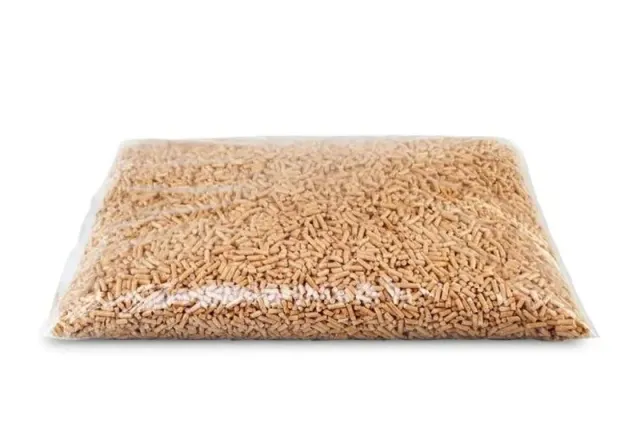
Wood pellets are 6 mm granules pressed from dry sawdust without glue or chemical binders: the pellet is held together by the wood's own lignin. They are the main fuel for domestic pellet boilers, pellet burners and pellet stoves with automatic feed. One kilogram gives about 4.7-5 kWh of heat, and less than one percent of ash remains after burning, so the ash pan of a domestic boiler needs emptying once every few days rather than daily.
Softwood or hardwood. Softwood pellets (pine, spruce) are the most common: thanks to the resin they have a slightly higher calorific value, less ash and a light colour. Hardwood pellets (oak, ash) are denser and heavier and burn longer, but produce slightly more ash. For most boilers the difference is not critical, so choose by price per tonne and availability. Pellets containing bark are darker and leave more ash.
Quality standard. The European ENplus standard divides wood pellets into classes A1 (ash content up to 0.7%, for domestic boilers) and A2 (up to 1.2%, for boilers with a larger ash pan and boiler houses). Moisture content under the standard is no more than 10%. Batch documents (the producer's certificate and test report) are provided on request together with the delivery note.
Packaging. A 15 kg bag is easy to carry and pour into the hopper; a pallet holds about a tonne, and a 100-150 m² house needs 3-5 such pallets per season. Big bags of about 1000 kg are for storage with a forklift. Bulk is delivered by truck and unloaded into a hopper or store, with the lowest price per tonne for boiler houses.
Price and delivery. Prices per bag and per tonne are in the table below; the price per tonne goes down with volume. Delivery across Ukraine: from our warehouse with our own transport, and to other regions by carrier on pallets. Wholesale supplies for boiler houses and dealers are made under contract, by bank transfer with VAT, with deferred payment for regular customers.
How to check wood pellets on delivery
The bag. Intact, dry, with the producer's markings; no more than a handful of sawdust at the bottom. If the bags are damp or noticeably dusty, check the batch more thoroughly before unloading.
The pellet. Smooth, shiny surface, clean cut, length 1-4 cm without long "tails" or cracks. Colour: uniform and light; dark specks mean bark or impurities.
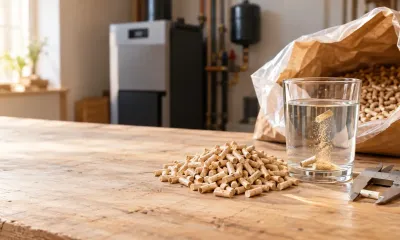
Strength test. A pellet is hard to break with your fingers and does not crumble when dropped from table height. Brittle pellets feed poorly through the auger and create dust.
Water test. In a glass of water, good pellets sink and break down into uniform sawdust within 5-10 minutes. If the pellets float or the water turns oily, they contain binders or impurities.
Documents. Ask for the producer's certificate and a numbered test report for the batch; an ENplus number can be checked on the standard's website. We provide the documents together with the delivery note.
These checks do not replace a laboratory, but they weed out most problem batches right at unloading.