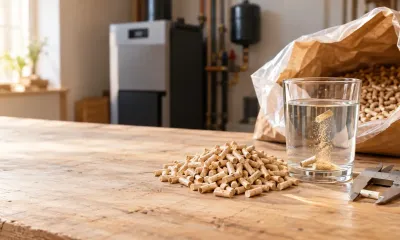
Agro pellets are granules made from sunflower husk, a by-product of oil production. Their calorific value is close to that of wood pellets (about 4.3-4.8 kWh per kilogram), but they cost noticeably less per tonne because the raw material is a by-product rather than sawdust. They are the cheapest type of pellet on the market and the main fuel for industrial boiler houses, greenhouses, dryers and farms where the boiler is designed for agricultural fuel.
The main difference from wood pellets is ash. Husk leaves 3-5% ash after burning, compared with less than 1% for wood pellets, and at high temperatures this ash can sinter into clinker. That is why agro pellets need a boiler with mechanised ash removal and moving grates, or a retort burner designed for agricultural fuel. In an ordinary domestic pellet boiler with a small ash pan, you would have to clean it daily and periodically clear clinker from the grate. If that is the kind of boiler you have, choose wood pellets.
Who benefits. Boiler houses of businesses and public facilities, greenhouse operations, farms with grain dryers, and owners of agro pellet boilers in private homes. With consumption of several dozen tonnes or more per season, the price difference per tonne outweighs the extra cleaning costs.
Packaging. 25 kg bags, big bags of about a tonne and bulk by truck. For boiler houses with storage, bulk and big bags are the main option, with the lowest price per tonne. Agro pellet production is seasonal and tied to sunflower processing: the widest choice is in autumn and winter, and for summer we recommend contracting your volume in advance.
Price and delivery. Prices per bag and per tonne are in the table below. Delivery across Ukraine: with our own transport from the warehouse, and to other regions by carrier. For boiler houses: a supply contract, bank transfer with VAT, a seasonal shipping schedule and a quality certificate for every batch.
Who benefits from agro pellets, and who doesn't
Worth it where a lot of fuel is burned and someone is available to clean the boiler: boiler houses of businesses and public institutions, greenhouses, grain dryers, farms, and production sites with their own heating. With consumption of tens or hundreds of tonnes, the savings on every tonne outweigh the cost of ash removal, and boilers for such sites are designed for agricultural fuel from the outset.
Conditionally worth it for private homes with a boiler whose manual explicitly states that it can run on agro pellets or husk, and which has automatic cleaning. The savings here are real, but you have to get used to more frequent maintenance.
Not worth it for owners of domestic pellet boilers with a small ash pan and fixed grates. Daily cleaning, the risk of ash sintering and reduced output eat up the price difference, and in a warranty case the boiler manufacturer may cite "fuel not complying with the manual". For such boilers, choose wood pellets.
Not sure which group your boiler falls into? Tell us the model over the phone and we will advise.